Why Is My Grow Tent Humidity Too High 7 Best Fixes?

Time:2026-10-16 Author:Oliver
0%

Why is my grow tent humidity too high? This question often appears beside fogged tent walls, damp soil, and curling leaves. High humidity rarely comes from one cause. Plant transpiration, poor ventilation, wet growing media, and a humid room can combine quickly. Even a healthy plant may release more moisture than a small tent can remove.

I have seen growers blame the humidifier, then discover water collecting beneath seedling trays. A reliable hygrometer usually reveals the pattern. Measure humidity at canopy height, not beside the floor or exhaust outlet. Check readings during lights-on and lights-off periods. Nighttime spikes are common because cooler air holds less moisture. Small details matter.

This guide explains seven practical fixes for managing excessive grow tent humidity. These include improving exhaust airflow, increasing gentle circulation, reducing unnecessary standing water, and controlling the surrounding room. Each solution should match your plant stage and local conditions. Seedlings, leafy plants, and flowering plants do not share identical humidity needs. A strong fan is not automatically the best answer. Too much wind can stress leaves and dry the surface unevenly. I have also underestimated room humidity before; the tent was working correctly, but the surrounding air was already saturated. Use a calibrated hygrometer, make one change at a time, and record the results. That approach is slower. It is also more dependable. Safe wiring and dry electrical connections must remain essential whenever water and equipment share the same space.
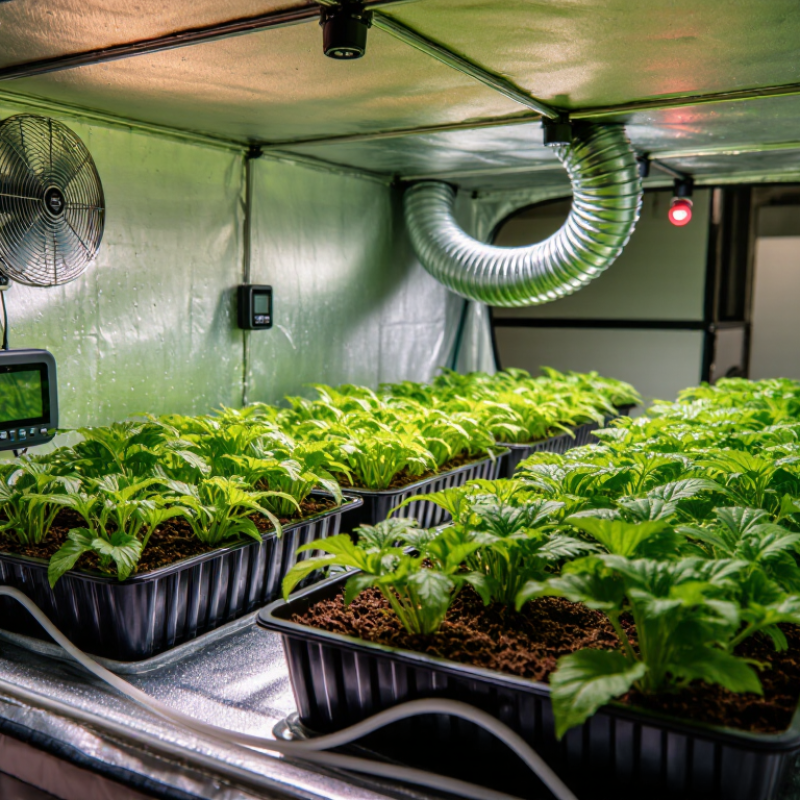
Why Is My Grow Tent Humidity Too High 7 Best Fixes?

Define High Humidity: Target 55–65% RH in Vegetative Growth

High humidity in a grow tent usually means RH stays above 65% during vegetative growth. A practical target is 55–65% RH, with 55–60% safer when leaves are dense. The U.S. EPA moisture-control guidance recommends indoor RH below 60% to limit mold growth. That benchmark matters, even in a plant tent.

Check humidity at canopy height, not beside the floor. Use a calibrated hygrometer, then compare readings from two areas. Improve airflow with an oscillating fan, but avoid blasting leaves continuously. Run exhaust when RH rises, and keep intake air unobstructed. A dehumidifier can help in damp rooms. Empty its tank daily. Water early in the light period, and remove runoff quickly. Reduce overcrowding. It is surprisingly easy to create a wet microclimate beneath overlapping leaves.

University greenhouse guidance often places vegetative crops near 50–70% RH, but crop response varies with temperature and airflow. At 65% RH, warm air may still support rapid transpiration. At 75% RH, wet surfaces can remain longer after watering. The EPA’s mold guidance supports treating 60% as a useful warning point, not a perfect biological rule. I would adjust gradually, about 3–5 percentage points daily, while watching leaf posture and drying time. My earlier mistake was trusting one cheap sensor. It read correctly, just in the wrong location.

Measure Accurately: Compare Hygrometer Readings at Canopy Level

Why Is My Grow Tent Humidity Too High? Measure Accurately First

High tent humidity may be a measurement problem, not a ventilation failure. A sensor near the floor can read differently from air around the canopy. Warm leaves, damp media, and stagnant pockets change local relative humidity.

The U.S. Environmental Protection Agency commonly recommends 30–50% indoor relative humidity, but that range is not a universal plant target. Use it as a household reference only. The ASHRAE Handbook also stresses correct sensor placement because temperature gradients can distort humidity readings.

Place two hygrometers at canopy height Place two hygrometers at canopy height, several inches apart, without touching leaves or tent fabric. Record temperature and RH every five minutes for at least thirty minutes. Keep the tent closed during testing. A brief door opening can create a false improvement.

If readings differ by more than 5% RH, inspect calibration, airflow, and sensor age.

I once trusted the higher reading too quickly. That was a mistake.

For a basic accuracy check, compare each instrument inside a sealed container with a humidity reference. ASTM E104 describes saturated-salt methods for maintaining known humidity levels, while NIST guidance emphasizes temperature control during humidity measurement.

Sodium chloride produces approximately 75% RH near room temperature, but the value shifts with temperature. Do not adjust every sensor blindly. Write down the offset, then repeat the test at canopy level.

A small circulation fan can reduce pockets, yet excessive airflow may dry one side of the canopy. Watch both readings.

Find the Source: Diagnose Water, Airflow, Temperature, and Leaks

High humidity in a grow tent usually has a source, not a single cause. Start with two calibrated hygrometers, placed at canopy height and near the floor. Compare readings for 24 hours.

The U.S. Environmental Protection Agency recommends indoor relative humidity below 60%, with 30% to 50% preferred for mold prevention. That range is a useful warning line, not a universal plant target.

Check wet floors, open reservoirs, dripping irrigation lines, and damp trays. Empty runoff immediately. Seal tears, loose duct joints, and nearby windows. Even a small leak can overwhelm a compact enclosure.

Airflow and temperature deserve equal attention. Keep an exhaust outlet clear, use gentle circulation across leaves, and avoid stagnant corners. Do not aim a strong fan directly at plants; stress can increase water loss unevenly.

ASHRAE’s HVAC guidance emphasizes controlling moisture through ventilation, dew point, and condensation management. Lowering temperature without reducing moisture can raise relative humidity.

Raise the room temperature slightly, improve exhaust, or add a correctly sized dehumidifier. Clean its filter often. Keep intake air away from bathrooms and laundry areas. A timer can stabilize nighttime ventilation, when humidity commonly rises.

Measure before changing everything. That lesson is easy to ignore. I would also record temperature, humidity, watering times, and outdoor weather for one week.

If readings remain high after watering stops, inspect hidden leaks and undersized ventilation. Data exposes assumptions.

Apply 7 Fixes: Ventilation, Dehumidification, Defoliation, and Water Control

High humidity in a grow tent often comes from trapped water, not faulty equipment. Place an exhaust fan near the tent’s upper outlet, and keep a lower intake open. Air should move across the canopy, not merely around the walls. The EPA recommends indoor relative humidity between 30% and 50%, while ASHRAE warns that sustained moisture encourages mold growth. A practical target depends on plant stage and temperature.

Apply these seven fixes.

  1. First, increase ventilation and check that ducting is not crushed.
  2. Second, run a properly sized dehumidifier outside the tent.
  3. Third, thin crowded leaves carefully; heavy defoliation can stress plants.
  4. Fourth, water only when the growing medium shows reduced moisture, not by habit.
  5. Fifth, empty runoff quickly.
  6. Sixth, raise air temperature slightly when safe, because cold surfaces collect condensation.
  7. Seventh, space containers and use two calibrated hygrometers, including one at canopy height.

Small details matter. A damp towel, wet floor, or open reservoir can raise readings overnight. The University of Minnesota Extension links poor air movement and leaf wetness with greater foliar disease pressure. I once trusted one inexpensive hygrometer; that was a mistake. Compare readings weekly, especially after watering, and record nighttime humidity separately. If humidity remains above 60% for hours, reduce moisture at its source before buying stronger equipment.

Verify Results: Maintain 0.8–1.2 kPa VPD and Prevent Mold Risk

When grow tent humidity stays high, mold can develop before leaves look unhealthy. I have seen condensation collect on tent poles after lights turn off. VPD offers a better check than relative humidity alone. Aim for 0.8–1.2 kPa during active growth, while checking plant response and leaf temperature.

Start by confirming readings with two calibrated meters. Place one at canopy height, away from direct airflow. Improve exhaust, open lower intake vents, and keep air moving gently around leaves. Avoid blasting plants. Remove standing water, reduce unnecessary watering, and empty trays after irrigation. A properly sized dehumidifier can help when the room itself feels damp.

Leave enough space between containers and prune only damaged or crowded foliage. Clean spilled soil and inspect leaf undersides daily. Temperature changes can shift VPD quickly, so check readings after lights turn on and before they switch off. My own mistake was trusting one sensor near the floor; canopy conditions were warmer and much drier. The target looked correct, but the plants still showed stress. Use VPD as guidance, not a rigid command, and adjust slowly while watching condensation, leaf texture, and any musty odor.

Why Is My Grow Tent Humidity Too High? 7 Best Fixes

Verify results by maintaining approximately 0.8–1.2 kPa VPD and reducing conditions that increase mold risk.

Fix Likely Cause Recommended Action Useful Target or Measurement How to Verify Results Mold-Risk Control
1 Improve air exchange
Stale air allows moisture released by plants and growing media to accumulate.
Use an exhaust fan to remove humid air and provide a passive or filtered intake. Keep the intake unobstructed and avoid sharply bending ducting. Maintain steady air movement without collapsing the tent walls. During lights-off, continue enough ventilation to prevent humidity spikes. Compare humidity near the plant canopy with humidity outside the tent. A sustained reduction after ventilation increases indicates better air exchange. Lower humidity around leaves and surfaces where condensation can support fungal growth.
2 Use a dehumidifier when needed
The room supplying air to the tent may already be humid.
Dehumidify the surrounding room rather than placing a large heat-producing unit inside a small tent whenever possible. Empty or drain the reservoir regularly. For many vegetative and flowering setups, begin by keeping room RH near 45–60%, then adjust according to plant stage and VPD. Measure RH before and after the dehumidifier runs for at least one complete light and dark period. Prevent prolonged high RH, especially during flowering when dense plant material dries slowly.
3 Control watering and runoff
Overwatering, poor drainage, or frequent surface saturation adds moisture to the tent.
Water according to the crop and medium’s needs, allow suitable drainage, remove standing runoff, and do not leave trays full of water. Use the growing medium’s moisture behavior and plant response rather than a fixed calendar. The root zone should not remain waterlogged. Record watering time, amount, runoff, and RH response. A sharp humidity rise after watering should gradually return toward baseline. Reduce damp surfaces and anaerobic root-zone conditions that can contribute to disease pressure.
4 Increase internal air circulation
Still air creates humid pockets inside the canopy.
Position oscillating or circulation fans so air moves gently through and beneath the canopy. Avoid directing strong airflow continuously at one leaf or stem. Leaves should move slightly, while the canopy should have no stagnant corners. Airflow should reach the lower and interior foliage. Use a handheld hygrometer at canopy height and compare readings at the tent entrance, center, and lower foliage. Reduce boundary-layer humidity and improve drying after irrigation or accidental splashing.
5 Manage temperature and VPD
RH alone does not show how quickly plants can transpire water.
Measure air temperature and RH at canopy height, then adjust temperature, humidity, or airflow gradually. Keep conditions stable rather than making abrupt changes. Aim for approximately 0.8–1.2 kPa VPD for a general growth range. The correct value varies with crop, growth stage, and leaf temperature. Use a calibrated hygrometer and a VPD calculator that accounts for temperature. Measure at the same location and time each day. Avoid very low VPD conditions that can leave foliage wet for longer and increase disease risk.
6 Reduce hidden moisture sources
Wet floors, open reservoirs, damp towels, and condensation can keep RH elevated.
Remove standing water, dry the tent floor, cover open reservoirs where appropriate, insulate cold surfaces, and inspect ducting for condensation. Keep the floor and tent walls visibly dry. Check corners, under containers, and behind equipment at least once per light cycle. Track RH with the tent empty for a short test and then compare it with the tent operating normally to identify moisture sources. Eliminate wet surfaces that can support mold growth or spread spores through moving air.
7 Calibrate sensors and automate safely
An inaccurate hygrometer can lead to unnecessary or ineffective adjustments.
Place sensors at canopy height, away from direct fan airflow, walls, lights, and humidifier outlets. Use an independent second sensor when possible. Check sensor agreement periodically and replace batteries as needed. Set alerts for sustained high RH rather than reacting to brief fluctuations. Compare two sensors in the same location for several hours, then verify readings at canopy height and during the dark period. Early alerts help correct humidity before condensation, visible mildew, or localized fungal problems develop.

Verification rule: VPD is calculated from temperature and relative humidity, and leaf temperature may differ from air temperature. Treat 0.8–1.2 kPa as a practical general range, then confirm plant response, condensation, and disease symptoms rather than relying on RH alone.

Safety note: Keep electrical equipment elevated and protected from water. Never allow fans, dehumidifiers, or power connections to contact runoff or standing water.

FAQS

What humidity level suits vegetative growth?

Aim for 55–65% relative humidity during vegetative growth. Keep closer to 55–60% when leaves form a dense canopy. Watch drying time, leaf posture, and nighttime readings. There is no perfect number.

Where should I measure humidity inside the tent?

Place a calibrated hygrometer at canopy height. Keep it several inches from leaves, fabric, and containers. Compare readings from two nearby locations. Floor readings can mislead you.

How can I check whether my hygrometer is accurate?

Place each sensor inside a sealed container with a humidity reference. Keep the container near room temperature. Record the reading and note any offset. Do not adjust every sensor blindly.

How long should I test humidity?

Keep the tent closed during testing. Record temperature and humidity every five minutes for thirty minutes. Avoid opening the door during measurement. A short opening can create false improvement.

What ventilation changes can reduce high humidity?

Position exhaust near the upper outlet. Keep the lower intake open and unobstructed. Move air across the canopy, not only around the walls. Avoid blasting leaves continuously.

Can a dehumidifier help with a damp tent?

Yes, a properly sized dehumidifier can reduce room moisture. Place it outside the tent when practical. Check and empty its tank daily. If humidity stays high, find the moisture source.

How do watering and runoff affect humidity?

Water during the early light period when possible. Remove runoff quickly from trays and floors. Water when the growing medium has partially dried. Do not water only by habit.

Should I remove crowded leaves to lower humidity?

Carefully thinning crowded leaves can improve air movement. Avoid heavy removal, because plants may experience stress. Space containers so air can pass between them. I once trusted one sensor too quickly.

Conclusion

Why is my grow tent humidity too high? Excess moisture usually comes from overwatering, poor air circulation, insufficient ventilation, temperature changes, or water leaks. During vegetative growth, aim for approximately 55–65% relative humidity and measure it accurately with a reliable hygrometer placed at canopy level, rather than near the floor or ventilation opening. Comparing readings in different areas can help identify hidden humidity pockets.

To correct the problem, improve intake and exhaust airflow, use a suitable dehumidifier when necessary, reduce standing water, and allow the growing medium to dry appropriately between waterings. Selective defoliation can also improve air movement around dense foliage, while sealing leaks and managing room temperature helps prevent condensation. After each adjustment, monitor humidity and temperature consistently, targeting a VPD of about 0.8–1.2 kPa. Stable readings, good airflow, and regular inspections will reduce mold risk and maintain a healthier growing environment.

Oliver

Oliver

Oliver is a seasoned marketing professional with a wealth of expertise in driving brand awareness and engagement. With a deep understanding of our company's product offerings, he consistently delivers high-quality content that enriches our professional blog. His insights not only shed light on......